

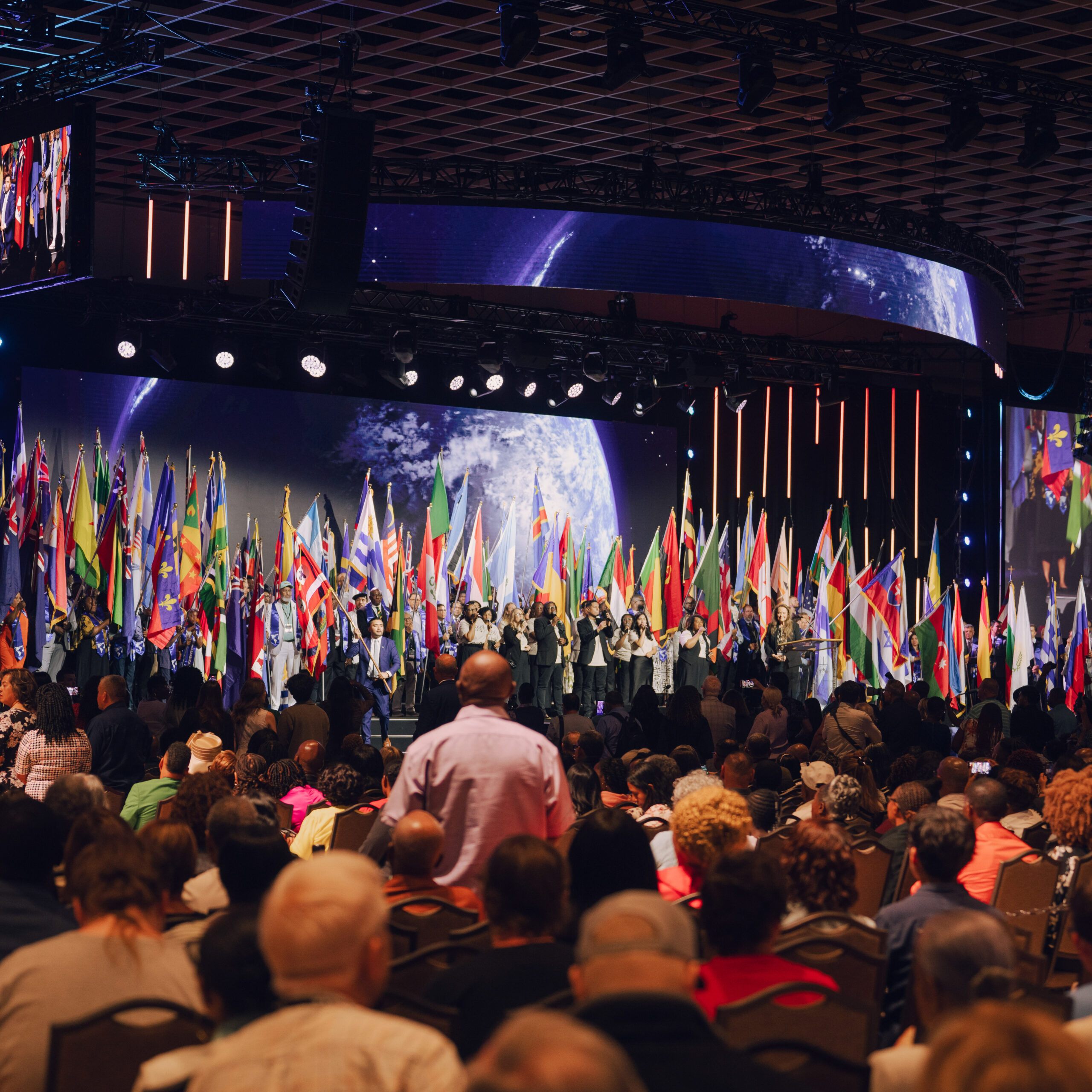
the Parade of Nations moved across the floor—flag after flag, nation after nation—a living tapestry of the global Church. Each step told a story. Each banner represented lives, languages, and lands touched by the gospel. It was more than ceremony; it was a visible declaration that the kingdom of God is not confined to one place, one people, or one culture.
Before a single sermon was preached, we were already witnessing something profound.
Now, weeks removed from that gathering, we find ourselves living in what I would call the afterglow.
In the natural world, an afterglow is the light that lingers after the sun has set. It softens the sky, stretches across the horizon, and reminds us that something radiant has just taken place. The source may no longer be visible in the same way, but its effects remain.
Scripture gives us a powerful picture of this kind of afterglow.
When Moses descended from Mount Sinai after being in the presence of God, the Bible tells us that his face shone with the glory of the Lord (Exodus 34:29–35). The radiance was so evident that the people were afraid to come near him. Eventually, Moses placed a veil over his face—not because the glory was absent, but because it was present.
That is afterglow—the visible evidence of having been in the presence of God.
Moses did not manufacture that radiance. He did not strive for it or perform for it. It was the natural result of encountering the Lord. And even as time passed, the glow of that encounter remained upon him.
In much the same way, what we experienced at the Assembly was not confined to those days on the calendar. The presence of God among us left an imprint—a spiritual radiance that continues even now.
The opening night Parade of Nations set the tone for that reality. As each nation passed before us, we were reminded that we are part of something far greater than ourselves. That awareness—that lingering clarity—is part of the afterglow. It is the realization that we are a Spirit-formed, globally connected people, and that what God is doing in one region is tied to what He is doing in another.
During the Assembly, there were powerful moments—worship that lifted us, preaching that stirred us, prayer that marked us. Yet often, it is in the days that follow that those moments begin to settle into meaning. What we experienced corporately now calls for personal expression. That is the work of the afterglow.
Like Moses, we may not always be fully aware of what rests upon us, but others will see it. There should be something different about how we return—something in our perspective, our priorities, and our posture—not because we are trying to preserve an event, but because we have been shaped by an encounter.
The September White Wing Messenger will capture in words and many pictures what we experienced at the Assembly: moments of unity, reverence, joy, and divine movement. But the true afterglow is not confined to the pages of a magazine. It is carried in the lives of those who were there.
The question before us is not whether the Assembly mattered.
The question is whether its radiance remains.
If Moses’s face shone as a result of being with God, then surely our lives should reflect something of His presence as well—not in a way that draws attention to ourselves, but in a way that points unmistakably to Him.
We cannot remain on the mountain—but we must not lose what happened there.
We carry it into our leadership.
We carry it into our churches.
We carry it into our witness before the world.
We move forward—not trying to recreate the moment, but faithfully stewarding what remains. And if we do, the afterglow will not fade into memory. Like the face of Moses, it will continue to shine, bearing witness that we have been with the Lord.
(Note: This article was edited by ChatGPT for structure, grammar, and clarity.)