
The sequence was not random:
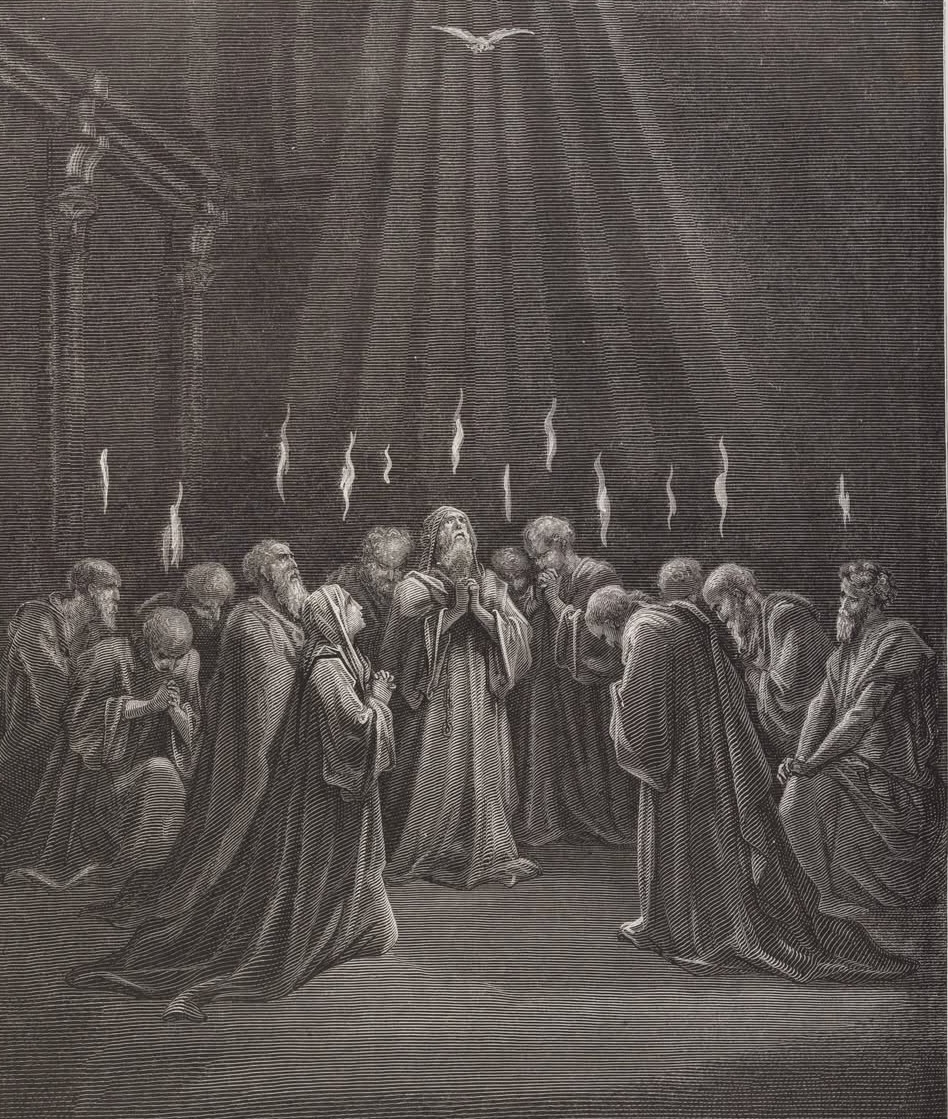
- The fire was personal – “. . . and one sat upon each of them” (Acts 2:3 NKJV).
- The power was corporate – “And they were all filled . . .” (Acts 2:4).
- The witness became global – “. . . and to the end of the earth” (Acts 1:8).
That day in the upper room, something shifted. God’s fire ignited them, His power equipped them, and their lives became a living witness from that moment forward. Their testimony was more than information; it was the evidence of transformation they had personally experienced. C. S. Lewis describes God rebuilding us from the inside out; that is what happened at Pentecost— not improved people but transformed ones.
Acts 2:1 states, “When the Day of Pentecost had fully come, they were all with one accord in one place.” This verse describes the timing—God’s appointed moment had fully come; the unity— they were with one accord (agreement in truth and aligned with the Spirit); and the commitment to be present—in one place. When the moment was right and the people were aligned with God, heaven responded. Pentecost did not happen in a room full of division; it happened in a room full of surrender. It had only been about 53 days since the Last Supper, the night before crucifixion, when the disciples were arguing about “which of them should be considered the greatest” (Luke 22:24). In just over seven weeks, God took them from arguing over position to being unified in purpose—and then He filled them with power. Power flows where division is removed. All the old offenses had been put to rest. Control had been released. There was no competition—just waiting in the presence of God.
The Greek word used for “one accord” in Acts 2:1 is homothymadon, which means “with the same passion,” “with one mind and one impulse,” or “in unified purpose.” The word is stronger than just “agreement.” It is not just thinking the same thing or being in the same room. It is about hearts being aligned, desires being aligned, and moving in the same direction internally. At Pentecost, they were not just in the same room—they were in the same spirit. They shared the same hunger for God. Without unity, momentum starts to slip, focus gets scattered, and people end up pulling in different directions instead of moving together. In the upper room that day, people believed something was about to happen. They were aligned, waiting for what Jesus said would come—the promise of Acts 1:4–5.
Pentecost Sunday reminds believers that God never intended His church to live on memory alone but by the present power of the Holy Spirit. More recent historical accounts of revivals and outpourings of the Spirit give us a taste of what God has in store for our day. Here are a few examples:
- The First Great Awakening (1730s-1740s) in the American colonies and Britain was characterized by deep conviction of sin, mass conversions, and powerful preaching accompanied by emotional and spiritual responses.
- The Second Great Awakening (early 1800s) occurred in frontier camp meetings in the United States. These large outdoor gatherings were marked by intense conviction and repentance. It resulted in growth of churches and the birth of many reform movements.
- The Prayer Revival (1857-1858) started in New York City and spread globally. It began as a simple noon prayer meeting that exploded into thousands of daily gatherings. Business districts shut down for prayer. Revival spread to Europe.
- In 1901, Charles Parham, a key figure in Pentecostalism, gave an account of a move of God that started at the Bethel Bible School in Kansas (USA). His report, paraphrased from “The Latter Rain,” is as follows:
In December 1900 Parham designated 40 students to determine the biblical evidence of the baptism in the Holy Ghost and to report their findings in three days. He was on a trip to Kansas City, and the students were to prepare their findings while he was gone and be ready to report them when he returned.
Their studies had already covered the following topics: repentance, conversion, consecration, sanctification, healing, and the soon coming of the Lord.
Parham returned in the morning before the watch night service on December 31, 1900. He was astonished when the students reported their findings that, while there were different things that occurred when the Holy Ghost fell, they spoke in other languages.
About 75 people gathered with the 40 students for the watch night service. They reported there was an intense power of the Lord present. At the service there was a student named Agnes Ozman (later LaBerge) that asked for them to lay hands on her to receive the baptism of the Holy Spirit. She believed she was called to be a missionary. At first Parham refused to lay hands on her because he didn’t have the Holy Ghost. She persisted. They laid hands on her head and prayed. Parham said he prayed about 3 dozen sentences when a glory fell upon her, a halo seemed to surround her head and face, and she began speaking in Chinese. She didn’t know Chinese. But for 3 days every time she opened her mouth to speak, it was Chinese. She decided to write a note to the others, but when she started writing, it was Chinese.
The students decided to tarry for two nights and three days. On the night of Jan 3, 1901, Parham preached at a Free Methodist church in Topeka. He told them he expected to return to the school that night to find everyone baptized with the Holy Spirit. On returning to the school, he heard sounds coming from the prayer room. He said the room was filled with a sheen of white light above the brightness of the lamps in the room. There were people gathered from 12 denominations. They had all received the baptism of the Holy Ghost and were speaking in other tongues. Some were trembling under the power of the glory that had filled them.
A Sister Stanley, an elderly lady, came to Bro. Parham and said she saw “tongues of fire” sitting above their heads just moments before he arrived. Parham asked God for the baptism. He heard God’s voice calling him “to declare this mighty truth to the world.” God told him that he would receive the baptism if he was willing to stand for it with all the persecutions, hardships, trials, slander, and scandal that it would entail. He made the commitment to God, and he was immediately filled with the Holy Ghost and began to speak in other tongues.
- The Welsh Revival (1904-1905) in Wales was defined by intense worship, repentance, and Spirit-led meetings. Its influence spread worldwide.
- The Azusa Street Revival (1906-1915) in Los Angeles, California (USA), marked by speaking in tongues, was renowned for its miracles and interracial worship, which was considered radical for that time. This revival birthed the global Pentecostal movement.
Maybe you have been waiting on God, but there are still places in your heart that feel pulled in two directions: between fear and faith, between control and surrender, between your plan and God’s purpose. You do not have to stay there. Let’s pray and ask God to ignite something fresh in every one of us. If you are hungry for more than just going through the motions, if you are tired of feeling dry, if something in you knows there is more—more power, more fire, more purpose than what you have been walking in—God is inviting you (and all of us) to surrender and let Him do what only He can do: transform us from the inside out.
Holy Spirit, we come into alignment. We lay down every distraction, every divided place. Fill us again. Send Your fire. Clothe us with Your power. Make us bold witnesses.
“Unified to Reconcile” is a purpose statement. It addresses why the church must be in unity. At its core, it means we come into unity so we can carry out the mission of reconciliation—together.
Resources
Lewis, C. S. “Counting the Cost.” In Mere Christianity. UK: William Collins, 2012.
Charles Parham. A Voice Crying in the Wilderness. Baxter Springs, KS: Apostolic Faith Bible College, 1902.
———. “The Latter Rain.” 1900–1901. Reprinted in The Apostolic Faith, April 1951. Apostolic Archives International Inc. https://www.apostolicarchives.com/articles/article/8801925/173163.htm.