

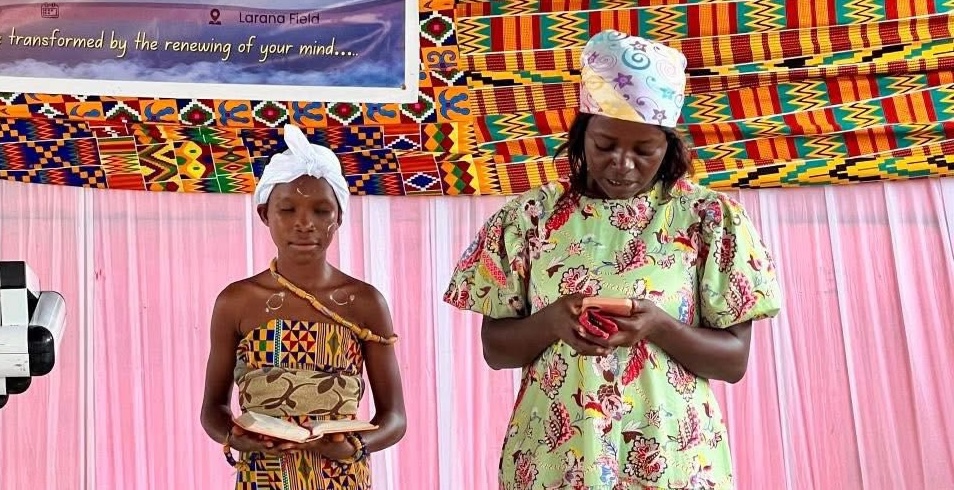
Before a young person ever finds the courage to share their faith, someone believed their voice was worth hearing. When we talk about empowering the next generation to testify, we often think about the big moments like camp testimonies and mission trip reports, but a testimony begins long before someone steps up to share it. The confidence a young person may have to share their faith is built up through dozens of smaller moments where elders gave them the opportunity for their voice, perspective, and ideas to make a difference. The question is not just “How do we create opportunities for youth to testify?” but “How do we create cultures where young voices are valued every day?” When young people know their voice matters in the mundane, they will speak with confidence in the extraordinary.
In leadership contexts within our churches, there seem to be two common viewpoints of young people. The first is seeing youth only as a lost generation, corrupted by culture, music, and media, needing to be saved from themselves, even if they are already walking with God. It is worth noting that this is not unique to Gen Z. Every generation tends to view the next one as more lost, more distracted, and more influenced by the world than they were. When youth are approached as a problem to solve rather than souls to disciple and empower, opportunities will be missed. Another viewpoint is the “cool factor” view—when a leader tries so hard to be modern, hip, and relevant. While rooted in good intentions, authenticity gets lost in the effort to connect. Young people need dependable leaders they trust and who will give guidance, even if those leaders don’t know the trends or use the newest slang. Both approaches miss what this generation really craves: community, connection, and authenticity. There is a reality worth naming: Anyone can access incredible sermons, professional worship music, and teaching content on their phone 24/7. What cannot be downloaded is relationship and the experience of being known and valued.
Think about the people who made a difference in your life at a young age. Much of their impact likely came simply from presence in the everyday. When I look at my own life, I see a youth pastor who came to birthday parties and volleyball games, and pastors and youth pastors who saw where I was gifted and gave me real responsibility to grow leadership skills while I was still young. When our youth praise band was encouraged to lead worship in the main sanctuary and not just in the church basement, my value was reinforced. There have been leaders in my life who gave students real ownership of decisions that mattered. In addition, I had parents who valued my input in family decisions and gave me opportunities to grow. To me, these are a few things that had a great impact on me. You probably have had similar experiences.
What is powerful about this approach is that elders walk alongside youth throughout life rather than outsourcing that responsibility to a program or a moment. They create space for young people to use their gifts, while still providing guidance and room to fail. Jesus modeled this beautifully in John 6:5–13. He could have multiplied the loaves and fishes without the small boy’s offering, yet He chose to involve the boy. The miracle was not only about feeding the five thousand; it was about a young person’s contribution mattering in something far bigger than themselves.
For many, the meaningful inclusion of young people can bring forth tension between excellence and the inclusion. As a self-proclaimed perfectionist, there is always the instinct to pursue the best idea, the most effective strategy, and strive for the most polished outcome. Many leaders experience this to some degree, and it is not wrong, because excellence does matter. God calls us to do things well so that it honors Him, but we cannot ignore a developing voice in our pursuit of perfection. Looking back at my youth ministry experiences, many of my own ideas and the ideas of other youth were underdeveloped, yet leaders took our thoughts and ideas seriously and created space for our imperfect contributions. They were forming something more valuable than a perfect program—they were letting us know our perspective had worth, while being guiding mentors to us. In Luke 10:1–2, Jesus sent out the 72 disciples knowing they would face hardship and that He could accomplish the mission more efficiently alone. The goal was not a flawless performance, but their formation.
This principle extends far beyond churches and youth groups. Many churches are small, with no formal youth ministry at all. However, everyone has a young person in their life, whether you are an aunt or uncle, maybe a grandparent, or even a neighbor to a youth; we have the opportunity to encourage and uplift their voices. This is a principle that educators have long understood. Montessori methods, for example, do not just teach skills to young children; they create a space where children contribute meaningfully to real work. Children practice doing things like pouring water, not just for the sake of it, but because the plants actually need watering. The learning happens through contribution, not simulation. The same principle applies to empowering young voices. Youth need to be a part of the decisions that affect them—whether it is helping plan a service project at church, contributing to decisions, or being given an opportunity to lead. When the voices of the youth shape real outcomes across everyday contexts, that is where “testimony confidence” is built.
Being treated as a valued voice by youth pastors, my parents, and leaders who trusted me with real responsibility made me feel like the leader people always said I was. That is what we get to offer the next generation. Empowering young voices is not just about creating testimony opportunities at camp. It is about forming the confidence that makes testimony authentic. When young people are included in real decisions, they learn their perspective has weight, and God can work through them now; and from that place, testimony is not something they perform, it is something they live.