

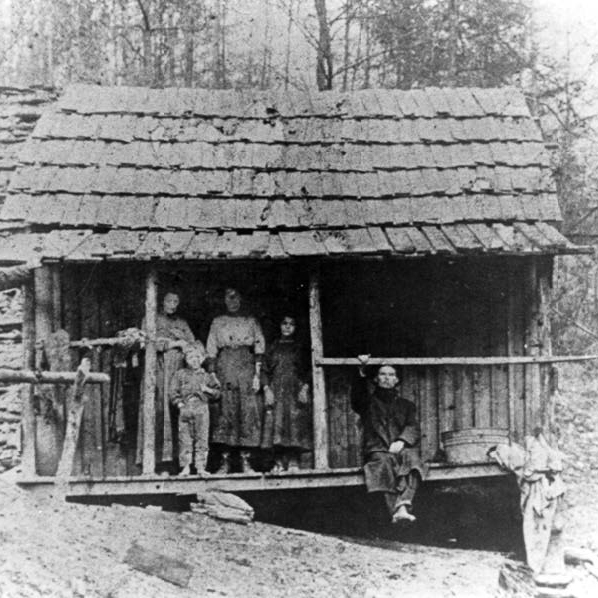
On June 13, 1903, A. J. Tomlinson wrote in his diary, “I was ordained a minister of the gospel of the Holiness Church at Camp Creek, N.C.”1
This Holiness Church had been organized in the house of William F. Bryant on Thursday, May 15, 1902, in Cherokee County, North Carolina. After the church was organized, “Brother Bryant was ordained. Brother R. G. Spurling was the man they chose as their pastor.”2
Joining this Holiness Church ended a long journey of searching for the true church for A. J. Tomlinson. After his conversion, he entered what he called a real conflict:
What church should I join? If there had been but one, as was the case in the time of the Apostles, I would have been saved that trouble. I searched and prayed and sought for information from people, books and papers. I was perplexed. I felt I was at a crisis. I did not know what to do. They were all different, and none of them really satisfied me, but I felt I must be a member of some church. If I had only known the Bible Church then! I finally decided to join the one nearest to my home, merely for convenience, as I thought I could do more good in one near by [sic], as I could attend more regularly.3
According to R. G. Robins, the church Tomlinson joined was the “Chester Preparative Meeting of the Society of Friends, organized by his grandparents.”4 However, joining this church did not end Tomlinson’s search for “the Bible Church,” as he called it. However, we can say that his search was somewhat finished when he joined the Holiness Church at Camp Creek in North Carolina.
It is interesting that in the entry of his diary for June 13, 1903, he only recorded that he “was ordained a minister of the gospel [chosen as pastor] of the Holiness Church at Camp Creek, N.C.,” without giving any explanation or details of the “rise and shine” of the church. Instead, it is in his book Answering the Call of God, in the section “Thirty Years in the Church of God,” where he explained what happened the day he joined the Holiness Church.
Even though Tomlinson called it “a blessed day to me,” he admitted, “I did not know it then like I do now.” After 30 years had passed, he could now reminisce and articulate what happened to him that day. Tomlinson remembered that a few friends met in the home of W. F. Bryant for prayer and study of God’s Word. He was interested in knowing what was “the Bible plan for the work that had to be done in the last days.” On this occasion, Tomlinson reported that “he had searched and investigated many movements until his faith in them had completely exhausted.” He compared himself to a ship at sea “with no rudder by which it should be controlled.” It was then that he “heard of the little band in Western North Carolina, and was acquainted with almost all of them, having preached for them several times and been with them in their meetings occasionally for four or five years before they had any form of organization.” Tomlinson “enjoyed their good free spirit and appreciated the warm welcome they always gave me when I would visit them.”5
In his recollection of events, Tomlinson recognized that the group had been organized as a church for about thirteen months before June 13, 1903. He continued:
I learned more about the organization at this time, and when I understood fully that they meant to stand for the whole Bible rightly divided and take the New Testament as their only rule of faith and practice, it appealed to me and I became very much interested at once. I poured in the questions and Bible answers were given which perfectly satisfied all of my inquiries. I then said, this means that it is the Church of God. To this they assented. Then I venture to ask if they would be willing to receive me into the Church with the understanding that it is the Church of God of the Bible. They were willing and soon proceeded in regular order. I took the obligation with deep sincerity and extreme sacredness never to be forgotten (Jer. 50:5).6
We can highlight several points from this declaration. First, Tomlinson’s mind was clear that they meant to stand for the whole Bible rightly divided, taking the New Testament as their only rule of faith and practice. Second, Tomlinson’s questions were biblically answered to his complete satisfaction. Third, he stated that it was not only the Church of God, but the Church of God of the Bible. Fourth, the church proceeded in regular order to offer him what he called “the obligation.”
Handing Tomlinson a Bible, R. G. Spurling offered these words of “the obligation”—“Will you take this as the Word of God, believe it and practice it, obey its precepts and walk in the light as God is in the light?”7 Tomlinson accepted this obligation, and with it, he became a member of the Holiness Church. It is important to mention that, for Tomlinson, the requirement to join this church was their commitment to accepting the whole Bible rightly divided. When they answered him positively, he declared, “Well, if you take the whole Bible rightly divided, that makes it the Church of God.”8 For Tomlinson, the fact that this group accepted the whole Bible rightly divided, making them the Church of God, meant he finally found the home that he had been searching for.
This year commemorates the 123rd anniversary of A. J. Tomlinson taking that obligation by which he became a member of the Holiness Church that later became the Church of God. Today, we continue with that same commitment of accepting the whole Bible as the Word of God, rightly divided. More than ever, we continue dedicated to doing our part in the fulfilment of the Great Commission of Jesus, reconciling the world to Christ through the power of the Holy Spirit. Let’s continue “rising and shining,” preaching the gospel to a suffering world, lifting up the name of Jesus, and bringing glory to God.
_____________________________________________
1 A. J. Tomlinson, Diary of A. J. Tomlinson 1901-1924, The Church of God movement Heritage Series (Cleveland, TN: White Wing Publishing House, 2012), 35.
2 Lillie Duggar, A. J. Tomlinson (Cleveland, TN: White Wing Publishing House, 1964), 33.
3 A. J. Tomlinson, Answering the Call of God (Cleveland, TN: The White Wing Publishing House, n.d.), 5.
4 R. G. Robins, A. J. Tomlinson: Plainfolk Modernist (New York, NY: Oxford University Press, Inc., 2004), 87.
5 Tomlinson, Answering the Call of God, 17.
6 Tomlinson, Answering the Call of God, 17–18.
7 Duggar, A. J. Tomlinson, 35.
8 Duggar, A. J. Tomlinson, 34–35.