

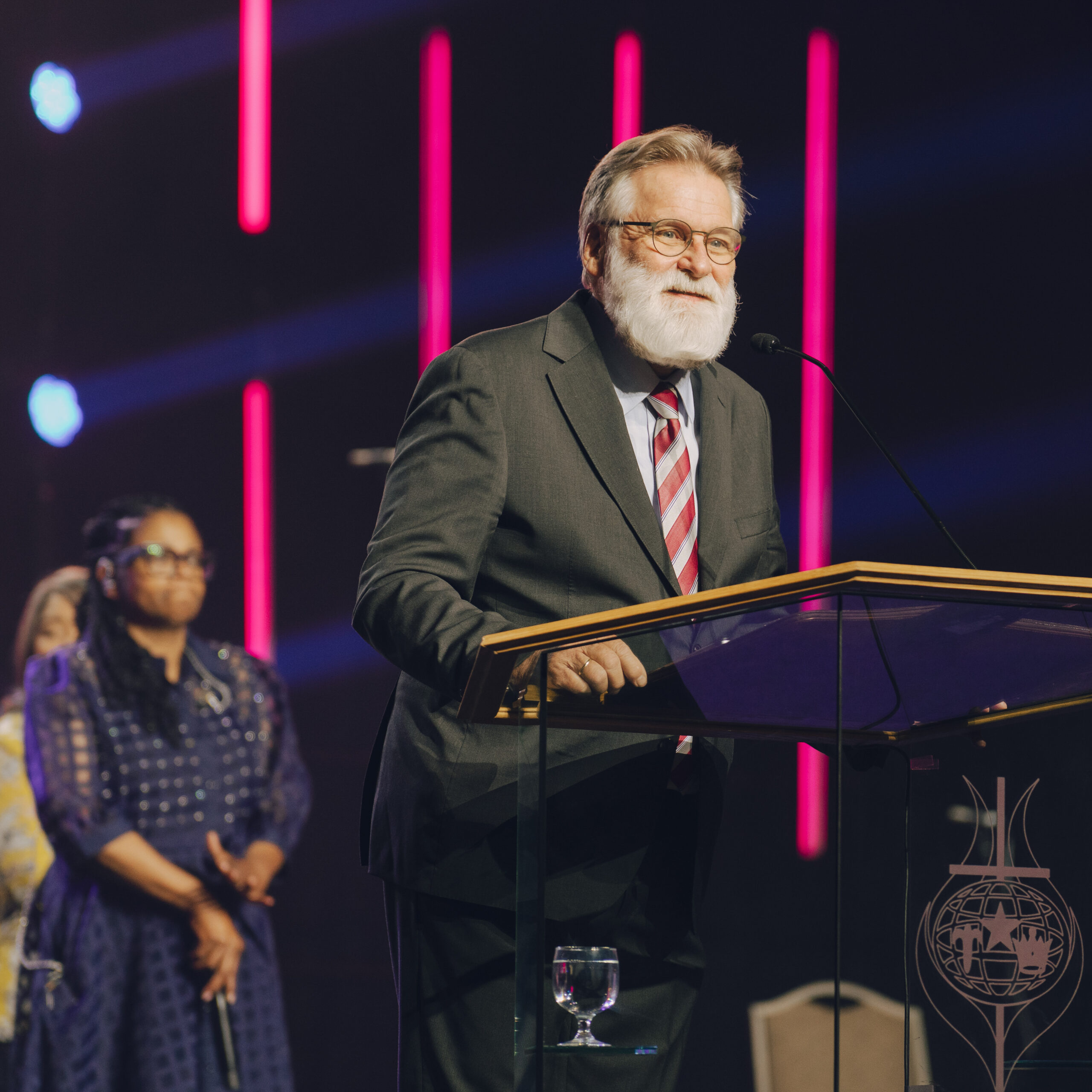
For nearly three decades as general presbyter for Wider Europe and the Middle East as well as more than four decades of missionary service before and during that assignment, Bishop Clayton Endecott has quietly helped shape one of the most complex and culturally diverse ministry regions in the Church of God of Prophecy. His influence can be found in churches planted, leaders developed, nations opened, theological conversations engaged, and generations of believers equipped to carry the gospel where it is often difficult, and sometimes dangerous, to do so. As he concludes this chapter of leadership, the Church pauses not simply to recognize years of service, but to honor a life consistently surrendered to the purposes of God.
At the center of that story has been the faithful partnership of his wife, Wanda. Together they have embraced every season of ministry, serving side by side through pastoral ministry, missionary work, and international leadership. One year after graduating from Tomlinson College, Clayton and Wanda were married and entered pastoral ministry. They began serving in Joliet, Illinois, later ministering in California before spending six fruitful years pastoring in Pekin, Illinois, where their first two sons were born. During those years, Brother Endecott was ordained as a bishop and began serving as a district overseer, but God was already preparing them for something much larger.
In 1983, with two young sons and what was intended to be a two-year commitment, the Endecotts moved to Langen, Germany, to pastor a congregation composed primarily of American military families. Few could have imagined that what began as a temporary assignment would become a lifetime calling.
Rather than remaining within the comfort of an English-speaking ministry, Clayton and Wanda immersed themselves in German culture. They learned the language, built relationships within the community, and reached young people through street evangelism and a Christian coffeehouse ministry known as the Teestube. Out of those early relationships grew something extraordinary.
In 1989, a German-speaking congregation was born in the Endecotts’ apartment. From those modest beginnings emerged a thriving movement. Today, multiple flourishing churches, additional church plants, and numerous mission works trace their spiritual heritage back to that simple act of obedience. Many of today’s pastors and leaders were once teenagers discipled under Clayton and Wanda’s patient investment in young lives, reflecting Bishop Endecott’s longstanding conviction that the future of the Church is built through developing leaders rather than simply establishing congregations.
That commitment to leadership development would shape not only Germany but an entire region. Young believers became mature disciples. Disciples became ministers. Ministers became church planters. Church planters became national overseers. Through that steady multiplication of leaders, the kingdom continued to expand in ways that no single ministry could have accomplished alone.
In 1993 Bishop Endecott was appointed overseer of Germany, Belgium, the Netherlands, and Finland. His responsibilities would eventually expand to include Hungary, Romania, Georgia, Azerbaijan, the Czech Republic, Cyprus, Greece, Italy, Ukraine, Israel, and additional nations across the region. Then, in 1998, when the Church of God of Prophecy adopted its plurality model of international leadership, he was selected as one of the denomination’s first general presbyters, serving the vast region of Europe, the Commonwealth of Independent States, and the Middle East.
Few ministry assignments have required navigating greater diversity. Within this single area are ancient Christian communities and newly planted congregations, thriving democracies and nations experiencing conflict, dozens of languages, countless cultures, and an extraordinary range of political and religious realities. Some ministries flourish publicly, while others advance quietly and wisely. Shepherding such a region has required more than administrative skill; it has demanded discernment, patience, cultural humility, theological depth, and unwavering dependence upon the Holy Spirit.
Those who have served alongside Bishop Endecott have consistently seen those qualities reflected in his leadership. He has been known as a careful listener before becoming a decisive leader, one who values local voices while maintaining a broad global vision and who approaches complicated situations with thoughtful wisdom rather than quick conclusions.
His preparation for such leadership reflects an unusual combination of pastoral experience and academic pursuit. After earning degrees in philosophy and psychology, he pursued graduate work at the University of Illinois before God’s call redirected his path toward Europe. In Germany, he continued studying biblical languages and theology at Goethe University and later pursued doctoral studies in Pentecostal constructive theology through Bangor University in Wales. His academic interests never became detached from ministry but instead strengthened his ability to serve the Church thoughtfully while engaging both theological scholarship and practical ministry.
That theological credibility also opened doors beyond denominational boundaries. Bishop Endecott served on the official Pentecostal- Catholic Dialogues initiated through the Vatican and participated in numerous German and international committees dedicated to fostering understanding among Pentecostal, Charismatic, and Evangelical believers. He also served on the board of the European Theological Seminary in Germany, investing in theological education for future generations of ministers.
Yet those who know him best are just as likely to speak of personal conversations as they are of impressive accomplishments. They remember encouragement offered at precisely the right moment, thoughtful questions that challenged them to grow, and a pastor who believed in them before they fully recognized God’s calling in their own lives.
One testimony from the Middle East illustrates this well. A young leader recalled that when opportunities for theological education seemed impossible, “Brother Clayton and his family saw in me what I could not see in myself.” That investment not only changed one man’s future but strengthened the ministry of an entire community during seasons of conflict and uncertainty. Stories like this have been repeated throughout the region, revealing one of Bishop Endecott’s greatest gifts: recognizing God’s calling in others and helping them develop it.
Throughout these decades of ministry, Wanda has faithfully shared in the work. Whether adapting to new cultures, opening their home, supporting ministry initiatives, or encouraging pastors and families across the region, she has been a steady partner whose quiet faithfulness has complemented her husband’s leadership. Together they have modeled a life devoted to God’s calling.
Their family likewise became part of that testimony. What began with two young sons arriving in Germany eventually became a family of four children, all of whom have married and served in churches throughout Germany and Europe. Today, their growing number of grandchildren continue that legacy of faith and service, providing one more reminder that ministry extends beyond public leadership into the lives of future generations.
Looking across the years, statistics tell only part of the story. Churches have multiplied, new nations have been opened, leaders have been trained, and the Church has expanded throughout the region under Bishop Endecott’s leadership. Yet numbers alone cannot measure spiritual influence. They cannot account for late-night conversations with discouraged pastors, prayers offered in hospital rooms or around conference tables, the courage required to minister through political upheaval and war, or the countless quiet acts of faithfulness that rarely appear in reports but are fully known to God.
As Bishop Endecott transitions from his role as general presbyter, the churches of Wider Europe and the Middle East stand as living testimony to what God can accomplish through ordinary people who simply continue saying yes to His call. His leadership has consistently pointed people toward Christ, invested in emerging leaders, and strengthened the mission of the Church across one of the world’s most challenging ministry fields.
His guiding verse has long been Joshua 24:15: “As for me and my house, we will serve the Lord.” Those words have not merely been quoted throughout his ministry; they have been lived across continents, cultures, and generations. Future pastors will preach in churches the Endecotts helped establish. Future missionaries will serve in nations they helped open. Future leaders will disciple others because someone first recognized God’s calling in their lives and took the time to invest in them. That is the enduring legacy of Bishop Clayton Endecott—a legacy measured not only by years of faithful service, but by lives transformed, churches strengthened, and generations prepared to carry the gospel forward. For that example, the Church of God of Prophecy offers its deepest gratitude.
Thank you, Bishop Clayton Endecott, for faithfully serving Christ, His church, and the nations. Your life reminds us that the most enduring ministries are not built on recognition, but on steadfast obedience to God’s call.