
2026 Costa Rica National Convention: Integral Mission
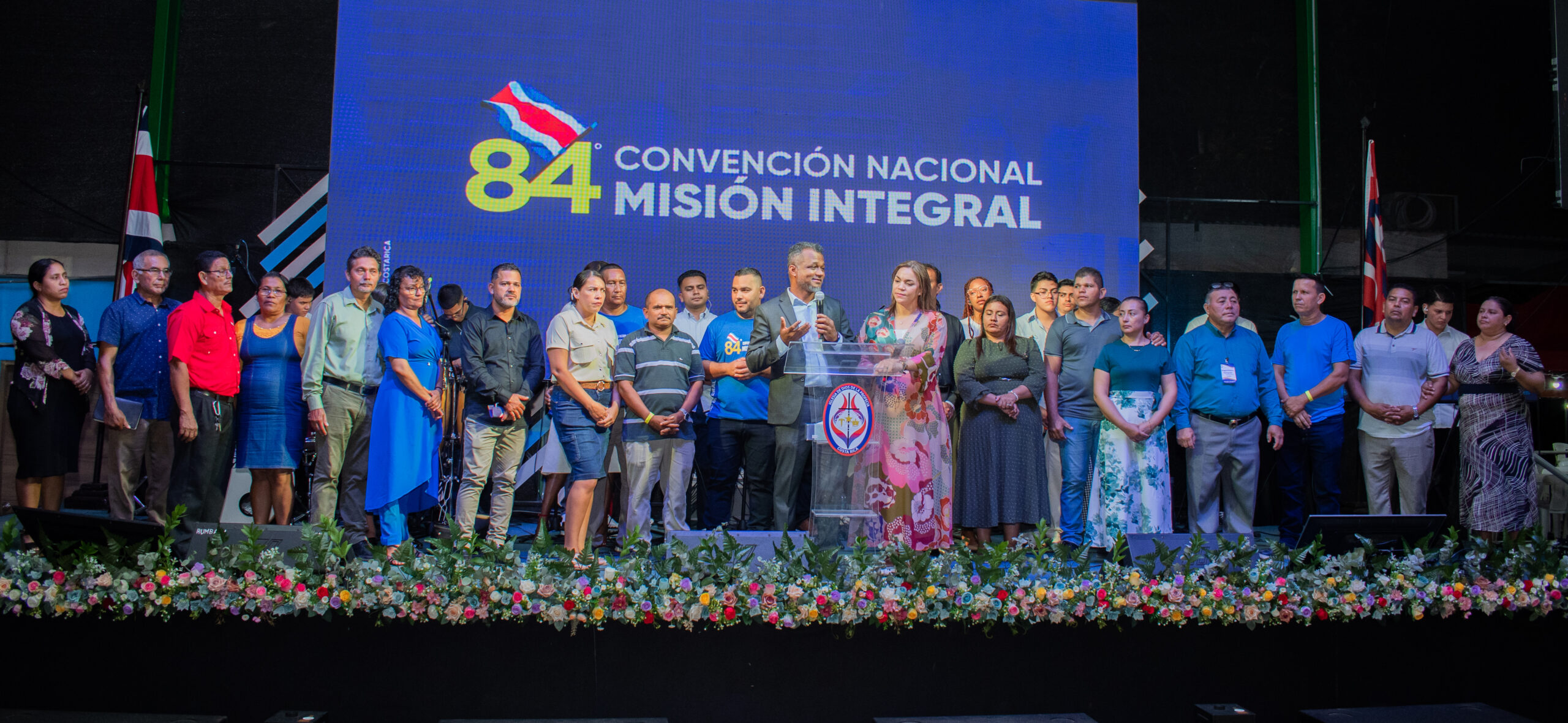
“Integral Mission” was the theme of the 84th National Convention held recently in Costa Rica. As a family of faith, we honor God for His goodness and constant care for the church in Costa Rica. During his opening address, National Bishop José Romero affirmed, “What is healthy must grow naturally.” With this statement, he reinforced the call to serve with devotion and to nurture the church’s growth through committed leadership, with Christ at the center.
Likewise, General Presbyter Bishop Ben Feliz noted in his first message that the church must be inclusive in carrying out its mission. This reality becomes clearer in the Pentecost story; people from all nations gathered, witnessing the outpouring of the Holy Spirit. This shows that speaking of integral mission in our times is not a response to a recent interpretation of the Word, but rather a return to the values of the kingdom that have been present since the beginning of the church’s work.
Along these lines, during the afternoon session of the first day of the convention, Pastor Harold Segura, a guest panelist, clearly explained how integral mission was embodied in the ministry of Jesus. First, he pointed out that the church should not prioritize strategy over compassion. Jesus focused on people: helping, teaching, and relieving their suffering. He did not come with complex plans to gain the political power of His time, but to bring salvation to the world. Likewise, He was not interested in condemning sinners; on the contrary, He shifted the emphasis from a morality of punishment to a morality of care, giving greater relevance to human suffering than to the condemnation of sinners.
During the evening session, Bishop Daniel Felipe, executive director of Finance and Administration, ministered the Word from John 5:1–18, which narrates the miracle at the Pool of Bethesda. In this text, he shared three fundamental truths about God’s mission, inviting the church to examine its understanding and practice of it.
First, he emphasized that God’s mission does not fit within our religious molds. Bethesda was considered an impure place; however, Jesus chose to go there on the Sabbath, breaking established rules.
He also pointed out that sometimes the church gives greater importance to protocol than to the mission. God’s love, he recalled, breaks protocol when it becomes an obstacle to grace and restoration.
Finally, Bishop Felipe emphasized that God’s mission challenges us to acknowledge our own mission. The pace of ministry, he said, should not be driven solely by human need, but by the mission that God has determined for each believer. It is not possible to fulfill that mission if we are not connected to the Owner of the mission.
On the second day of the convention, we celebrated the Entrepreneurs Fair, an event designed to promote businesses originating from the talent and work of brothers and sisters of the Church. This initiative reflected the focus of integral mission in concrete terms, recognizing that the care of human beings encompasses all areas of life, including the financial dimension.
During the evening session, Bishop Ben Feliz shared the Word through an inspiring sermon, reminding those in attendance that even when various political figures seek to get closer to the church, the church is not indebted to politicians or parties, nor does it exist to achieve fame or greatness. The purpose of the church is to be faithful to the mission that God has entrusted to it.
He also emphasized that, in the current context, the church should not be known only for what it condemns, but for what it does: for its testimony, its service, and its commitment to the needs of the people.
The last day of the convention began with a group baptism, in which some 85 people descended into the waters to be baptized. This moment marked a significant step in advancing God’s work, as new members were integrated into the Church of God of Prophecy.
Finally, Bishop José Romero moderated the closing session, expressing that holiness is not a unilateral effort but comes from God. He also pointed out that the mission demands obedience and commitment; individually, it is not always possible to burn with sufficient strength, but united, we are strong. In a context marked by weariness in the face of empty, orthodox speeches, he recalled that what moves people’s hearts is not only words but also actions. He concluded by affirming, “The most powerful fire does not make noise; it burns in silence, and it illuminates everything.”
Veron Christian Educational Center (CECRIVE): A Church Responds to the Needs of the Community
A relevant church responds to real needs to impact its community.
When the church lives faithfully to its mission, it transcends the walls of the church building and becomes a concrete response to its community’s needs. It not only proclaims hope, but it builds it through actions that transform realities.
At the beginning of the year 2000, the community of Veron, in the province of La Altagracia, Dominican Republic, lacked sufficient educational spaces for its children. As a result, many children were left out of the school system. Faced with this reality, the Church came to the conviction that it was both possible and necessary to respond. That vision, shared with pastoral leadership and assumed with faith, gave way in 2003 to the creation of the Veron Christian Educational Center (CECRIVE).
The school was founded as a nonprofit social welfare project, starting with a classroom for kindergarten level students, welcoming children aged four to five. It did not arise from an abundance of resources, but from a firm conviction: to offer holistic formation in which academic learning would go hand in hand with human values and a biblical foundation.
Since then, CECRIVE has become much more than an educational institution. It has been a support for families and a tangible expression of a church committed to its environment. More than two decades after its founding, although the project is not an economically profitable initiative, its social and human impact continues to be evident in the generations it has formed.
This testimony reminds us that a relevant church is one that listens, acts, and serves. Where there is a need, there is also an opportunity for faith to come alive and transform the community.
At present, the education center has an enrollment of 505 students, which is evidence of its sustained development and of the community’s trust in its educational project. This educational work transcends the classroom, as the center directly serves and supports more than 450 families, contributing not only to students’ academic education but also to their comprehensive formation in values, thereby strengthening the social fabric and community commitment.
This sustained growth over the years reaffirms the organization’s vision and commitment to the comprehensive education of the community. From having started with only one kindergarten classroom, the center now has a complete kindergarten and primary level, as well as the first cycle of the secondary level and one grade of the second cycle, showing significant and orderly progress. In coherence with this trajectory, the institutional projection is aimed at completing the secondary education offering, so that adolescents can remain in the center and finish their education there, without the need to move to other institutions, thus strengthening educational continuity and a sense of community belonging. Furthermore, we intend to become a semi-private center, a strategy that will allow us to continue strengthening the quality of education while expanding the services we offer, without losing sight of our social mission. This step responds to our commitment to sustain an inclusive educational model that guarantees access and permanence for the children of low-income working families, ensuring that institutional growth always goes hand in hand with equity, solidarity, and service to the community.
In short, the center continues to move forward with a clear Christ-centered vision of responsible growth, committed to educational excellence and inclusion, seeking to expand its offerings and improve its services without ceasing to serve the working families that have been and will continue to be the heart of its mission.